

KYPSO Mission
The mission of the Kentucky Post School Outcomes Center (KYPSO) is to increase the capacity of Local Education Agencies (LEAs), teachers, parents, and adult service providers to implement exemplary transition planning and increase post-school success for students who graduated a year ago. To distinguish between individuals who are enrolled in school and those who completed the YOYO a year after graduation, we will refer to those who completed the YOYO as “exiters”. KYPSO works closely with these units as well as Special Education Regional Technical Assistance Centers (SERTACs) and the Kentucky Department of Education (KDE) to provide data and training related to improving transition outcomes for youth with disabilities. KYPSO develops and oversees the Youth One Year Out former student interview (YOYO), which collects valuable post-school outcome data. This data includes measures of employment, post-secondary education, and training for students with disabilities one year after exiting high school. The employment data includes their experiences and the degree to which their work might be considered integrated and competitive. This data is often used for research by both KYPSO and its partners, and to inform recommendations for supports, services, and professional development aimed at improving post-school outcomes for people with disabilities.
Introduction
KYPSO is KDE’s contractor for the collection of post-school outcome data for exiters who had an Individualized Education Program (IEP) in place at the time they exited high school. This includes data related to the federal requirement for Indicator 14 under the Individuals with Disabilities Education Act (IDEA) and other post-school data necessary and appropriate to improve transition services for youth with disabilities throughout Kentucky. Data is collected through the YOYO former student interview developed by KYPSO and administered by district-level personnel whom KYPSO trains. The YOYO is pre-populated with demographic information provided by the state and includes a series of questions related to post-school employment and education; factors contributing to an exiter’s personal experiences; involvement with agencies; living arrangements; and community engagement. The YOYO also asks for general feedback regarding how former exiters’ high schools prepared them for adult life. Attempts were made in the spring and summer of 2024 to interview all former students who exited a public high school in Kentucky during the 2022-2023 school year with an IEP in place at the time of exit. Because the YOYO includes exiter identification numbers, KYPSO has the potential to link findings to other databases to identify malleable factors related to post-school success. These other databases include Least Restrictive Environment (LRE), pre-Employment Transition Services (pre-ETS), and Career and Technical Education (CTE) data, etc. To learn more about how KYPSO can help use YOYO data along with other databases to further investigate program effectiveness, contact Dr. Tony Lobianco, KYPSO’s Principal Investigator and Project Director at tflobi1@uky.edu.
Indicator 14
“Exiters who received special education” are defined as…

KYPSO is KDE’s contractor for the collection of post-school outcome data for exiters who had an Individualized Education Program (IEP) in place at the time they exited high school. This includes data related to the federal requirement for Indicator 14 under the Individuals with Disabilities Education Act (IDEA) and other post-school data necessary and appropriate to improve transition services for youth with disabilities throughout Kentucky. Data is collected through the YOYO former student interview developed by KYPSO and administered by district-level personnel whom KYPSO trains. The YOYO is pre-populated with demographic information provided by the state and includes a series of questions related to post-school employment and education; factors contributing to an exiter’s personal experiences; involvement with agencies; living arrangements; and community engagement. The YOYO also asks for general feedback regarding how former exiters’ high schools prepared them for adult life. Attempts were made in the spring and summer of 2024 to interview all former students who exited a public high school in Kentucky during the 2022-2023 school year with an IEP in place at the time of exit. Because the YOYO includes exiter identification numbers, KYPSO has the potential to link findings to other databases to identify malleable factors related to post-school success. These other databases include Least Restrictive Environment (LRE), pre-Employment Transition Services (pre-ETS), and Career and Technical Education (CTE) data, etc. To learn more about how KYPSO can help use YOYO data along with other databases to further investigate program effectiveness, contact Dr. Tony Lobianco, KYPSO’s Principal Investigator and Project Director at tflobi1@uky.edu.
Table 1 – Response rates by subgroup
| Kentucky YOYO 2024 | Target Group | Respondents | Difference Target |
|---|---|---|---|
| Female | 32.8% | 32.9% | 0.1% |
| -3.8%* | |||
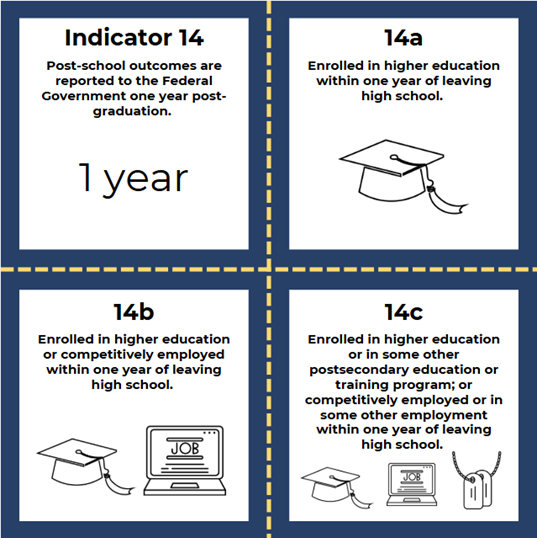
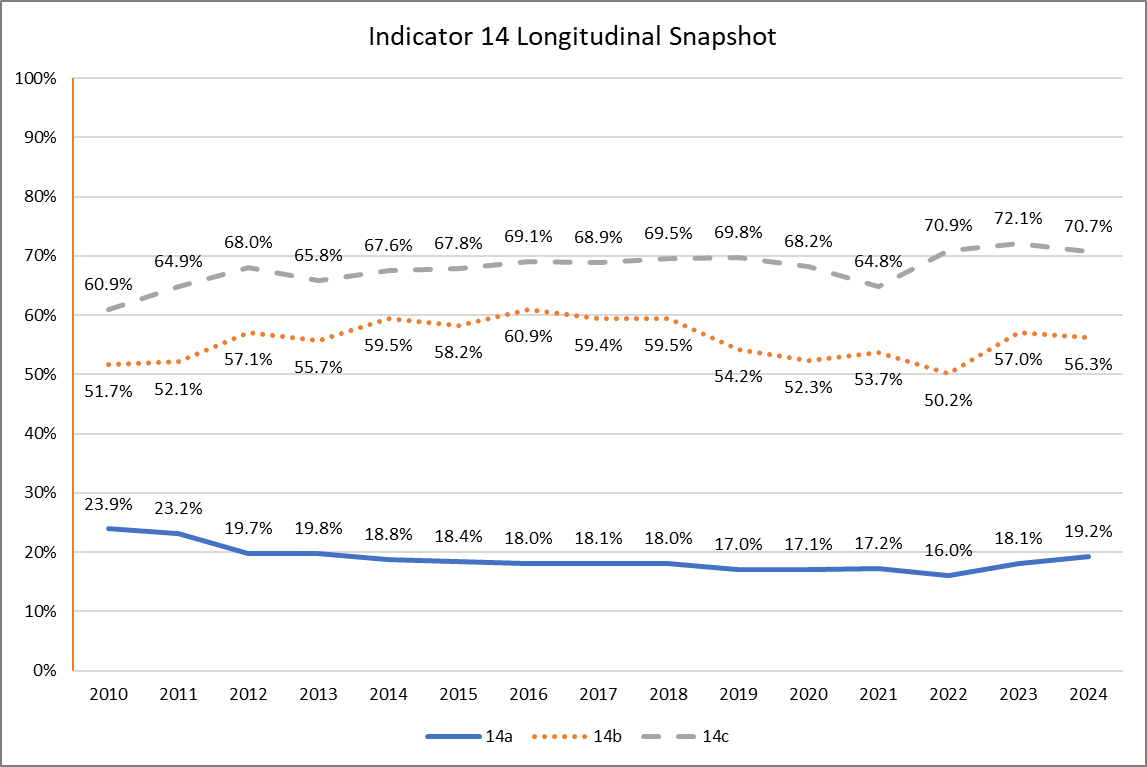
Figure 1 – Indicator 14 Longitudinal Snapshot
Indicator 14 Definitions
- Enrolled in higher education means youth have been enrolled on a full- or part-time basis in a community college (2-year program) or college/university (4- or more year program) for at least one complete term, at any time in the year since leaving high school.
- Competitive employment means that youth have worked for pay at or above the minimum wage in a setting with others who are nondisabled for a period of 20 hours a week for at least 90 days at any time in the year since leaving high school and had similar wages, benefits, and opportunities for advancement as their coworkers without disabilities. This includes military employment.
- Enrolled in other postsecondary education or training means youth have been enrolled on a full- or part-time basis for at least 1 complete term at any time in the year since leaving high school in an education or training program (e.g., Job Corps, adult education, workforce development program, vocational-technical school which is less than a 2-year program).
- Some other employment means youth have worked for pay or been self-employed for a period of at least 90 days at any time in the year since leaving high school. This includes working in a family business (e.g., farm, store, fishing, ranching, catering services, etc.). It also includes those indicating that they work in a segregated setting or do not receive comparable wages, benefits, and opportunities for advancement as their non-disabled co-workers; otherwise known as “sheltered workshops”.